What it controls
Cylindricity is a comprehensive form control for a cylinder. The whole surface must sit between two coaxial cylinders separated by the stated tolerance. The entire cylindrical surface: its roundness, straightness, and taper together.
The tolerance zone
How the zone works
The entire actual cylindrical surface must lie between two coaxial cylinders separated by the tolerance. Unlike circularity, the zone applies across the full controlled length at the same time.
Example drawing
See Cylindricity on a drawing
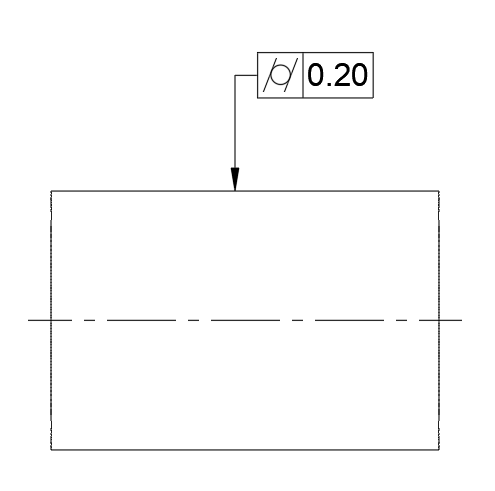
Tolerance zone visualized
See the tolerance zone in context
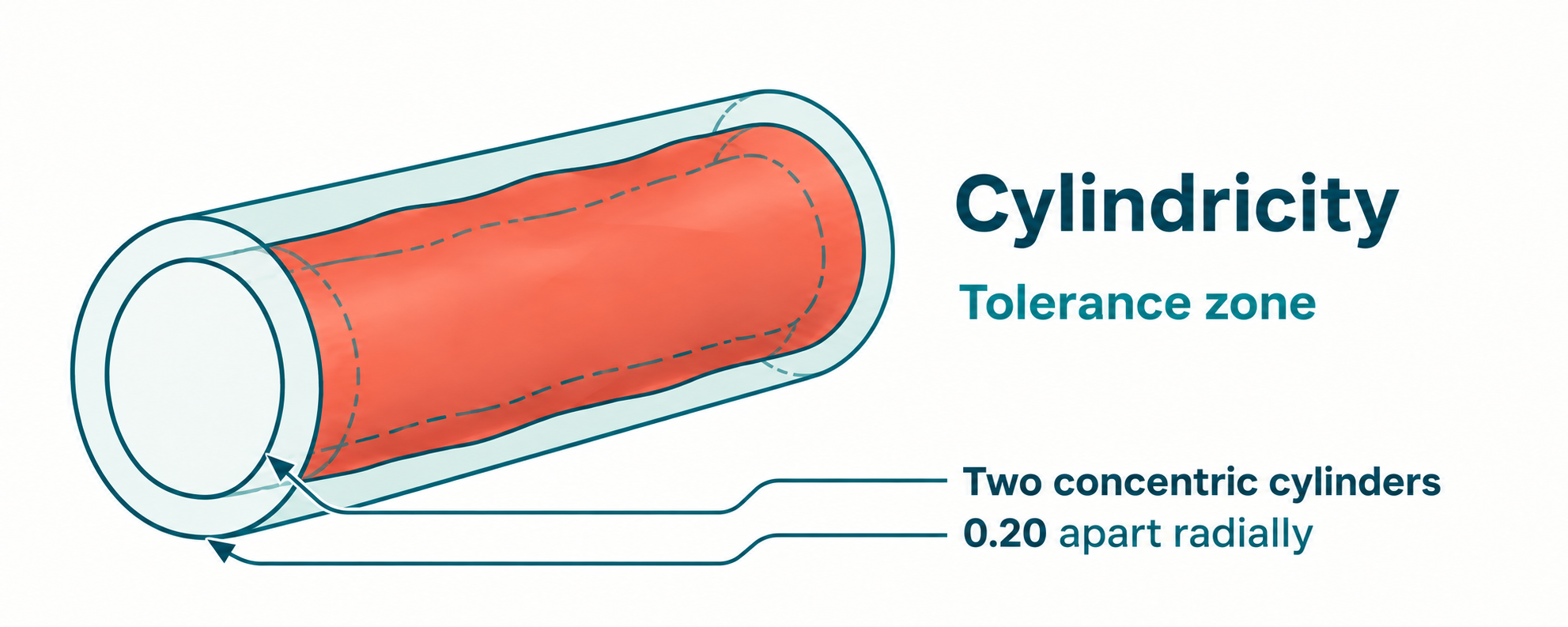
The complete cylinder, not a single slice
Cylindricity combines several form effects into one requirement: local roundness, longitudinal straightness, and taper of the cylindrical surface. It is still a form control, so the coaxial zone is free to orient and locate itself to best fit the actual surface.
Example feature control frame
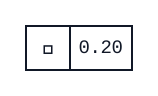
The indicated cylindrical surface must remain within a 0.20 mm cylindrical zone over its complete controlled length.
Practical use
When to use Cylindricity
Use cylindricity for critical journals, precision bores, or sealing diameters when the complete surface must function as a cylinder—not merely be round at individual sections.
Inspection
How it is usually measured
A CMM, roundness/cylindricity instrument, or scanning system can sample the complete surface and compute the best-fitting coaxial boundaries. An indicator at one or two locations is not enough: it may miss taper or a local lobe elsewhere on the diameter.
Common mix-up
It is more demanding to make and inspect than circularity, so use it only when the whole surface function requires it.
Keep exploring
 Straightness
 Flatness
 Circularity
 Profile of a Line
 Profile of a Surface
 Angularity
 Perpendicularity
 Parallelism
 Position
 Circular Runout
 Total Runout
 Concentricity
 Symmetry