
What it controls
Concentricity controls the derived median points of a feature relative to a datum axis. It may be encountered on older drawings, but ASME Y14.5-2018 withdrew it in favor of more practical controls such as position or runout when appropriate. The derived median points of a cylindrical or spherical feature.
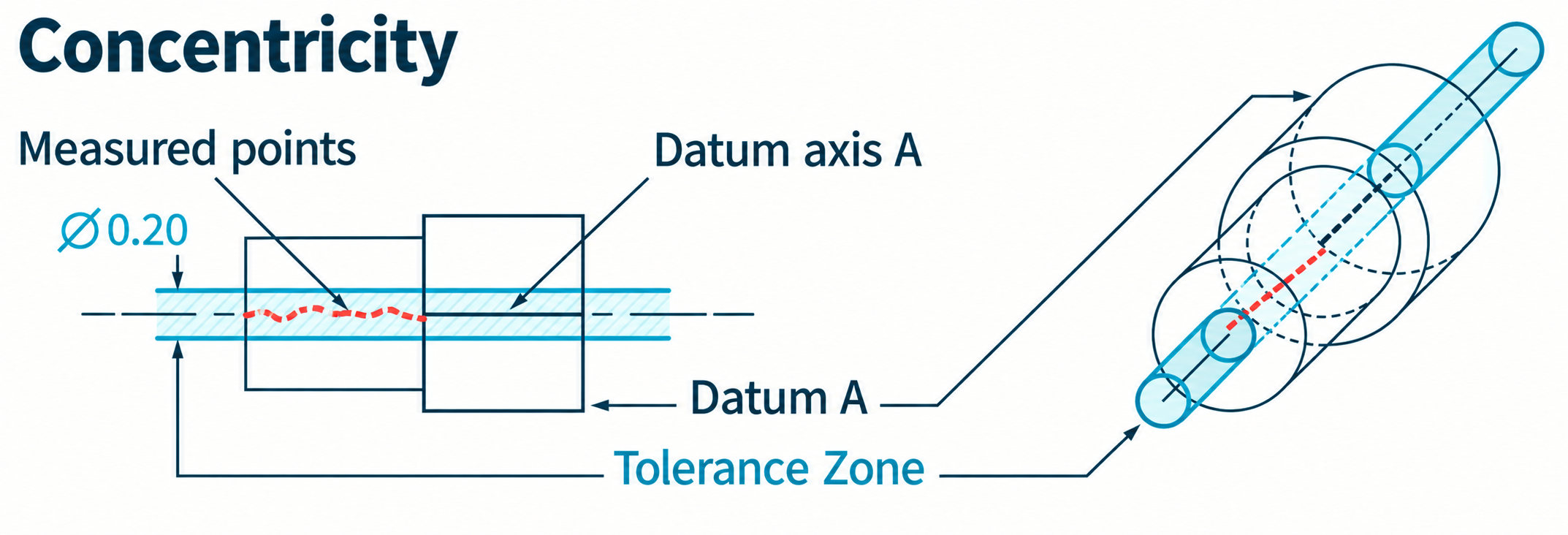
The tolerance zone
How the zone works
The derived median points of the controlled feature must lie within a cylindrical zone centered on the datum axis. This is not the same as requiring the actual surface to have low indicator reading during rotation.
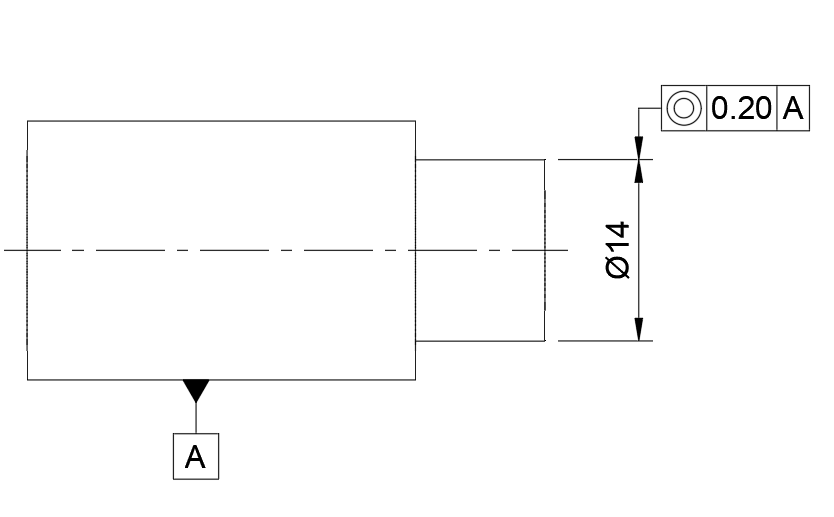
Example drawing
See Concentricity on a drawing
Tolerance zone visualized
See the tolerance zone in context
Why it is a specialized control
Concentricity controls the relationship of median points, which are constructed from opposed surface elements. That makes the requirement difficult to measure directly and often more restrictive than a design team intends. When the functional need is axis location or surface behavior during rotation, position or runout is usually a clearer choice.
Example feature control frame
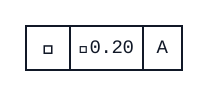
The derived median points of the indicated diameter must remain inside a ⌀0.20 mm cylindrical zone coaxial with datum axis A.
Practical use
When to use Concentricity
Reserve concentricity for the rare situation where the distribution of material around a datum axis—not simply the location of an axis or the spinning surface—is the actual functional requirement.
Inspection
How it is usually measured
A CMM is the practical choice because it can collect opposed surface points and construct the median points. An indicator on a rotating diameter measures runout, not concentricity, so it cannot by itself prove this control.
Common mix-up
Concentricity does not directly control the surface itself and can be difficult to inspect. Check whether position or runout better reflects the actual functional need.
Keep exploring
 Straightness
 Flatness
 Circularity
 Cylindricity
 Profile of a Line
 Profile of a Surface
 Angularity
 Perpendicularity
 Parallelism
 Position
 Circular Runout
 Total Runout
 Symmetry